




johndoe@gmail.com

by Jack Solloway
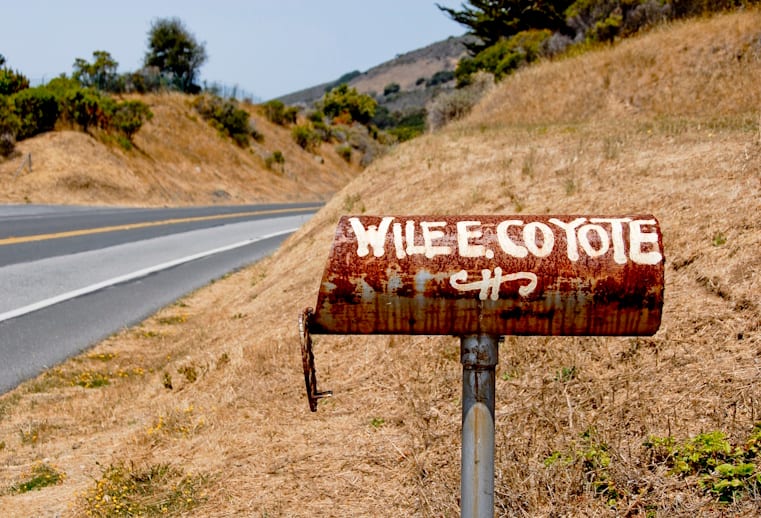
"Fanaticism consists in redoubling your effort when you have forgotten your aim."
— George Santayana
When George Santayana, the Spanish-American writer and philosopher, wrote of fanaticism in his Life of Reason (1905), he couldn't have predicted it would be used to describe a cartoon coyote for a children's television show.
Chuck Jones, creator of the Road Runner cartoons, borrowed Santayana's definition to characterize Wile E. Coyote, the show's antagonist. A lone predator and self-professed "super genius," Wile E. devises harebrained schemes that consistently fail in their attempt to catch his elusive prey, the Road Runner, a fleet-footed bird whose only dialogue is "meep-meep!" But what is it about Wile E., a loser undeterred by failure, that captures our imagination?
Coyote vs. Acme (2026), the long-awaited feature film, reprises Chuck Jones's anti-hero from the Looney Tunes' classic series. A once loyal customer of the nefarious Acme Corporation, Wile E. takes the mail-order giant to court over their malfunctioning wares. "Not all underdogs are dogs" reads the poster – and here at the Bloomsbury Visual Arts hub, we've curated a selection of free-reads inspired by the topic.
In this latest featured content, we explore Wile E.'s character development, the importance of ethical design, and the underdog in visual storytelling.
Wile E. Coyote, consumer champion?

Starring comedian Will Forte as a down-on-his-luck personal injury attorney, Coyote vs. Acme brings Ian Frazier's 1990 humor piece for The New Yorker ("Coyote v. ACME") to the big screen. The film, a live-action courtroom comedy, pits Wile E. Coyote in a legal dispute against the Acme Corporation, as he seeks damages in a product liability case for defective and dangerous products.
John A. Bruce, in his chapter on "Morality" in Designing in Dark Times, considers the ethical implications of Wile E.'s case: "The ACME Corporation supplied […] 126 different items to assist in his persistent, and always failed, labor to foil the Road Runner." This includes "a box of one thousand Tornado Seeds, a Rocket-powered pogo stick, a plethora of faulty explosives," all of which "lacked reliable use value while their variety, availability, and delivery were assured".
For Bruce, Acme's fictional negligence and poor customer relations serve as a useful metaphor for real-world capitalist consumption. As the American co-writers of "Advertising and Games" put it, "Rule 1: Tell the truth. Rule 2: Don't rip anyone off." Or else the Federal Trade Commission will get involved.
Frustration is the mother of invention

"Wile E. Coyote never learns," writes Nancy Beiman in Animated Performance. "This reveals a flaw in the coyote's character […] since he persists in believing that this time, the technology will work." We laugh expecting him to fail. His rigidity inspires laughter, typifying what French philosopher Henri Bergson called "something mechanical encrusted on the living" – a comic character doomed to go through the motions and repeat them like an automaton – where Wile E. falls (often literally) short of his namesake. Jennifer Johnson summarizes this motion in her chapter on "Making as Thought": "Reality, Bergson wrote, ‘is mobility. Not things made but things in the making […] only changing states exist."
If the coyote really is wily, he is wily to a fault. The pratfall is his character in the making. In other words, as Rolf Giesen and Anna Khan put it, it's precisely because Wile E. never learns that he's "one of the best creations conceived by Chuck Jones and his main storyboard artist Michael Maltese." In "Famous Cartoon Animals" Giesen and Khan describe Wile E. as his "own worst enemy," suggesting his character arc might actually be a character loop, a series of repetitions whose shape is infinitely recursive.
Chuck Jones established the format and drew up a set of "rules" for the show (e.g. "The Coyote's clever traps invariably backfire on him."). In it, he quotes Santayana on fanaticism to describe how Wile E. Coyote's motivations underpin the narrative. "The more frustrated, the more wildly inventive he becomes," write Giesen and Khan. "Wile E. is that kind of fanatic."
That is a nice boulder
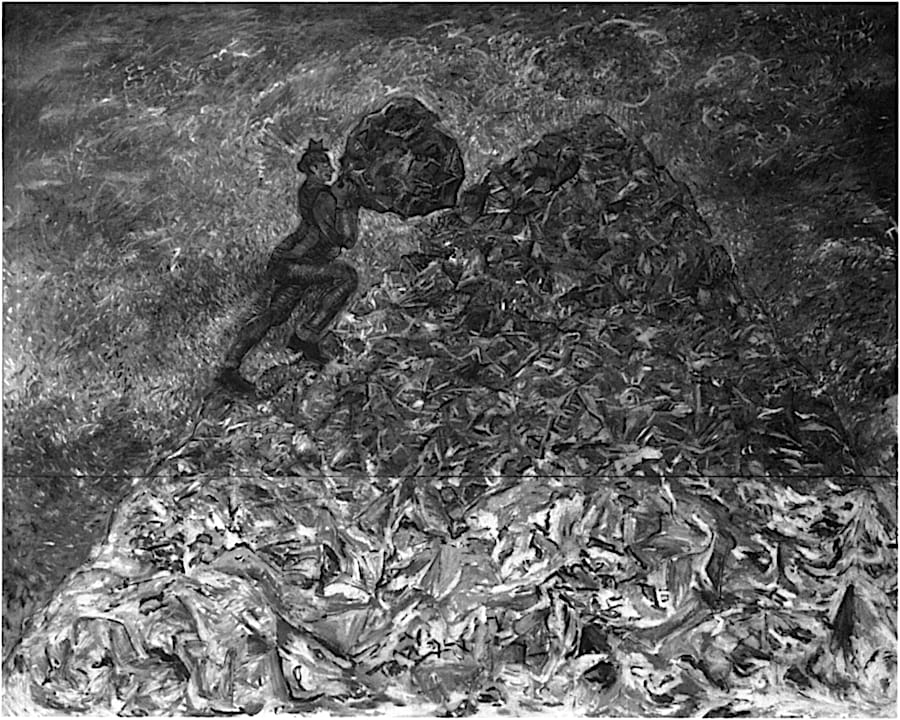
If Wile E. Coyote's fanaticism is absurd, we love him for it. The film poster for Coyote vs. Acme depicts him pushing a boulder-sized bomb up a steep incline in the New Mexico desert. Not only must one imagine the coyote happy, as Albert Camus did Sisyphus, but we must imagine that there is something about the spectacle of his Sisyphean task that inspires joy in us too.
"Although Camus ultimately asks us to ‘imagine Sisyphus happy' and asserts that the ‘struggle itself towards the heights is enough to fill a man's heart,'" Elly Thomas writes, "this is a consolation" and an insufficient one at that, since it doesn't account for the joy we take in the absurd process of boulder-rolling (i.e. the struggle itself).
Thomas's chapter on "Absurd Processes" instead asks us to consider the very "notion of repetition as play, [where] each time a ‘rock is rolled' the activity becomes created anew and a different meaning is produced." This could well describe an episode of the Road Runner, but for Thomas it's as much a generative process as it is an absurd or even comic one.
As an inventor of a kind, Wile E. would do well to heed the words of Philippe d'Anjou, who compares the designer's predicament to Sisyphus's lot, "endlessly roll[ing] a boulder up and down a hill." In Ethical Design Intelligence, d'Anjou writes that "as long as he chooses to hold and push the boulder Sisyphus keeps himself alive; he therefore engages his absurd situation in a futuring way."
"This is why we always identify with the pains the Coyote suffers," write Giesen and Khan in Acting and Character Animation. His constant plans, blueprints, and schemes, fanatical though they may be, keep him moving forward. "It is the same as in daily life."
That's not all folks! Content linked to in this blog will be free for three months after the post date.
For full access to our cross-searchable collections on the Bloomsbury Visual Arts hub, visit our Librarians page for information on trials and purchasing.
Explore the News and Updates page for the latest launches and collection updates.
